UK Innovation Districts Group’s (UK IDG) latest landmark report demonstrates the significant economic and social impact of UK innovation districts.
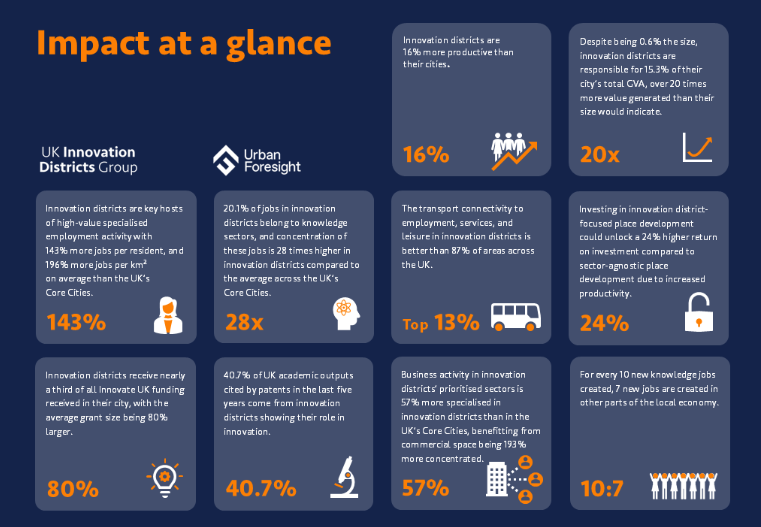
- Innovation districts are 16% more productive than their city average.
- Innovation districts deliver 24% higher return on investment than sector agnostic place development sites.
- Innovation districts generate 15.3% of their city’s total GVA despite being just 0.6% of their city’s size (more than twenty-times the return relative to their size).
- Innovation districts host 143% more jobs per resident and 196% more jobs per km² than the UK’s Core Cities average.
- 20.1% of jobs in innovation districts belong to knowledge sectors, and concentration of these jobs is 28 times higher in innovation districts compared to the average across the UK’s Core Cities.
- For every 10 new knowledge jobs created, a further 7 jobs are created elsewhere in the local economy.
- Innovation districts secure nearly a third of all Innovate UK funding received in their city, with the average grant size being 80% larger than grants issued outside the innovation district.
- 40.7% of UK academic outputs cited by patents in the last five years come from innovation districts showing their role in innovation.
- Innovation districts are 8% less deprived than the average across the UK’s Core Cities.
Commissioned by UK IDG and prepared by Urban Foresight, the report, “The power of data for Innovation Districts“, introduces a new data-dashboard combining 92 indicators to analyse performance across the three stages of the innovation cycle: design, delivery, and diffusion. The data tracks how innovation districts turn investment into impact. The full report examines the availability of localised publicly accessible data, the challenges of data collection and interpretation to measure ‘impact’, and makes recommendations on how innovation districts can collect and use data moving forward to clearly demonstrate the ‘value’ of innovation districts as vehicles for inclusive economic growth.
Developed to help overcome persistent barriers in localised public data accessibility, the dashboard provides a roadmap for evidence-based place-making.
The findings reveal that innovation districts are highly productive powerhouses that have a central role to play in delivering the UK Industrial Strategy. Despite occupying just 0.6% of their cities’ physical size, they generate 15.3% of total GVA – an economic return more than twenty times their footprint. Furthermore, UK innovation districts are 16% more productive than their surrounding cities, translating into a 24% higher return on investment compared to other sector-agnostic developments. They also act as critical R&D magnets, hosting 143% more jobs per resident and securing nearly a third of all municipal Innovate UK funding, with an average grant size 80% larger than elsewhere in their cities.

The power of data for Innovation Districts
Emma Frost, Chair of the UK Innovation Districts Group, said: “This data shows that innovation districts are powerful catalyst sites, helping to transform the fortunes of UK urban economies. By capturing these insights, and developing a roadmap for data collection and data exploration, we are supporting place-based leaders across the UK to build their business case, design their places, and attract investment for maximum return.
“With a 24% higher return on investment and a demonstrable 16% uplift in productivity, investing in targeted innovation districts is a proven path to regional growth. Moving forward, establishing shared local data standards will be vital to unlock their full potential and shape long-term UK economic policy.”
Eamon Banerjee, Consultant for Urban Foresight, said: “Innovation districts are increasingly recognised as catalysts for economic growth, but understanding their true impact requires looking beyond headline economic indicators.
“Through this analysis, we found that the most meaningful impacts of innovation districts are often not captured by conventional measures alone. This new framework provides a more complete picture of how investment is translated into innovation, business activity and wider place-based outcomes. The framework is designed to help places access funding support, understand what makes their places work, and make more informed strategic decisions.”
The report delivers benchmark data to all UK IDG Members and makes recommendations for UK innovation districts and knowledge quarters to build robust local data partnerships and internal analytical capacity. This will enable onward measurement of broader socio-economic outcomes and support place leaders to collaborate on highly productive, inclusive urban renewal.