
In 2020 Leeds’ innovation proposition reached global audiences, when visitors from across the world attended the city to see first-hand how Leeds inspires innovation. The visit was part of a prestigious programme (2018-2020), offered by the Massachusetts Institute of Technology (MIT). At that time, Leeds was developing its own ambitious plans for the city and region, and by hosting the MIT Regional Entrepreneurship Acceleration Program (MIT REAP) international workshop, the city took the opportunity to showcase its strengths to global leaders.
This autumn, during the UK Innovation Districts (UK IDG) Study Visit in Leeds, UK IDG Members saw the progress Leeds has made to accelerate its innovation ecosystem since MIT REAP and the development of the city’s Innovation Arc. Key achievements include the expansion of Nexus as a thriving commercial enterprise hub, the development of specialised assets like Virtuocity, the integration of sports and health tech through the Carnegie School of Sport, Leeds Teaching Hospitals Trust’s Innovation Pop-Up and the planned development of the Old Medical School into a new Healthtech Hub.
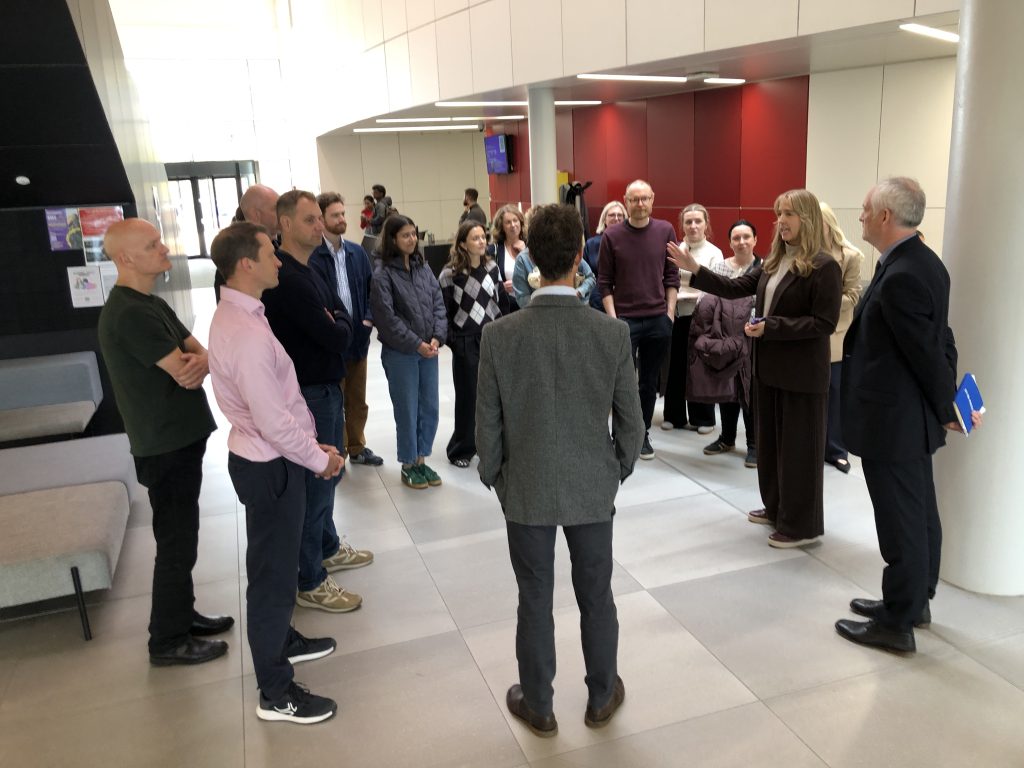
During the UK IDG Study Visit, which convened place leaders from innovation districts across the UK for two days, Leeds demonstrated what is possible when universities, NHS trusts, local government, and private developers align with communities around a shared civic and economic mission.
Fiona Bolam, Chief Officer for Economy and Skills at Leeds City Council, said, “It was fantastic to welcome the UK IDG to Leeds again and share our plans to drive innovation further across Leeds as we look to grow the Leeds Innovation Arc, adding 1 million sq ft of innovation space across a £2 billion development pipeline. The group has enabled us to make connections throughout the UK and learn and test ideas across academics, businesses and government.”
The study visit commenced at Leeds Beckett University’s Headingley Campus with opening addresses from Fiona Bolam, Chief Officer for Economy and Skills at Leeds City Council, and Silke Machold, Pro-Vice Chancellor of Research and Innovation at Leeds Beckett University.
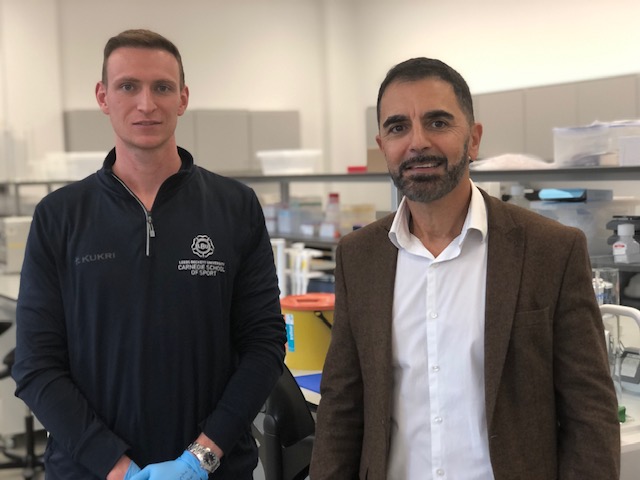
Guided by Susan Backhouse, Professor and Director of Research and Knowledge Exchange in the Carnegie School of Sport at Leeds Beckett University, delegates toured Carnegie Innovation, the university’s Sport Health Tech Incubator, and the Carnegie School of Sport, examining how specialised clusters can build regional economic resilience while directly addressing public health challenges.
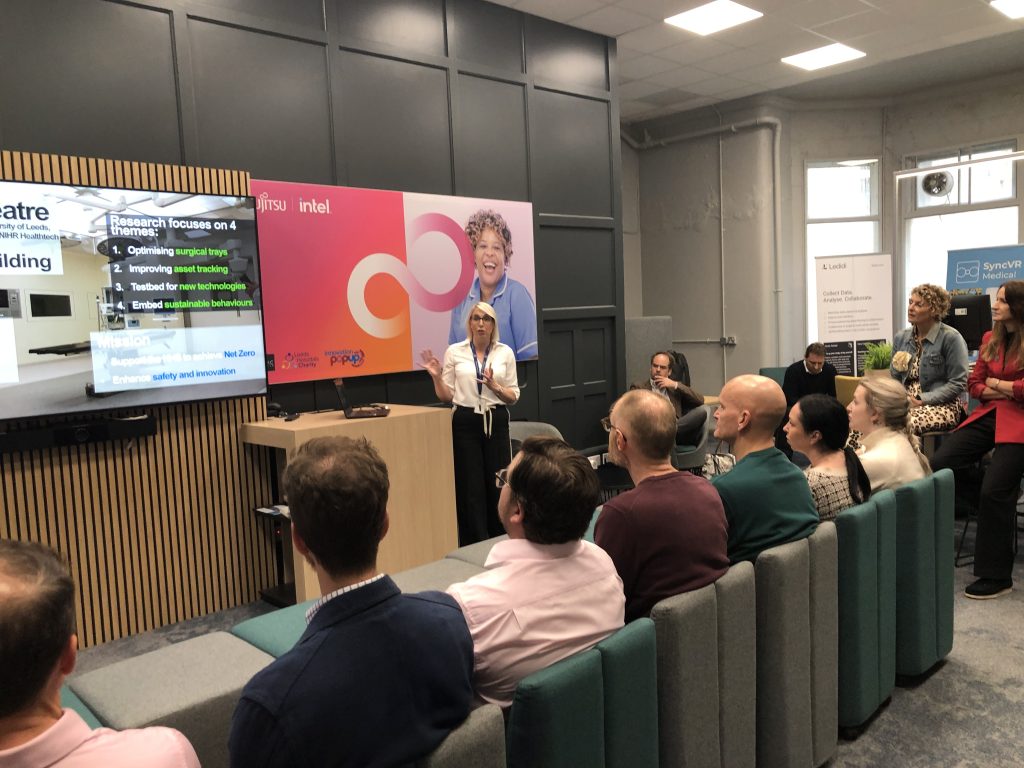
Returning to the city centre, UK IDG Members toured the redevelopment of the historic Old Medical School (OMS). Led by Deb Hetherington, Director of Innovation Ecosystems, and Mark Jackson, Development Director at Scarborough Group, the tour highlighted how heritage architecture will be repurposed into high-tech health hubs. Coupled with a visit to the Leeds Teaching Hospitals Trust’s Innovation Pop-Up, guided by Development Director Tori Critchley, Members heard how clinical and community collaborations will create better health outcomes for local people, as well as jobs and research opportunities from the newly developed specialist spaces.
The evening provided space for ecosystem networking over dinner at Friends of Ham, featuring insights from Stuart Clarke, Founder of Leeds Digital Festival, and Leeds Digital Director Deb Hetherington on the growth of the regional tech community. The session emphasised a core UK IDG principle: innovation districts thrive when physical assets are backed by strong community networks.
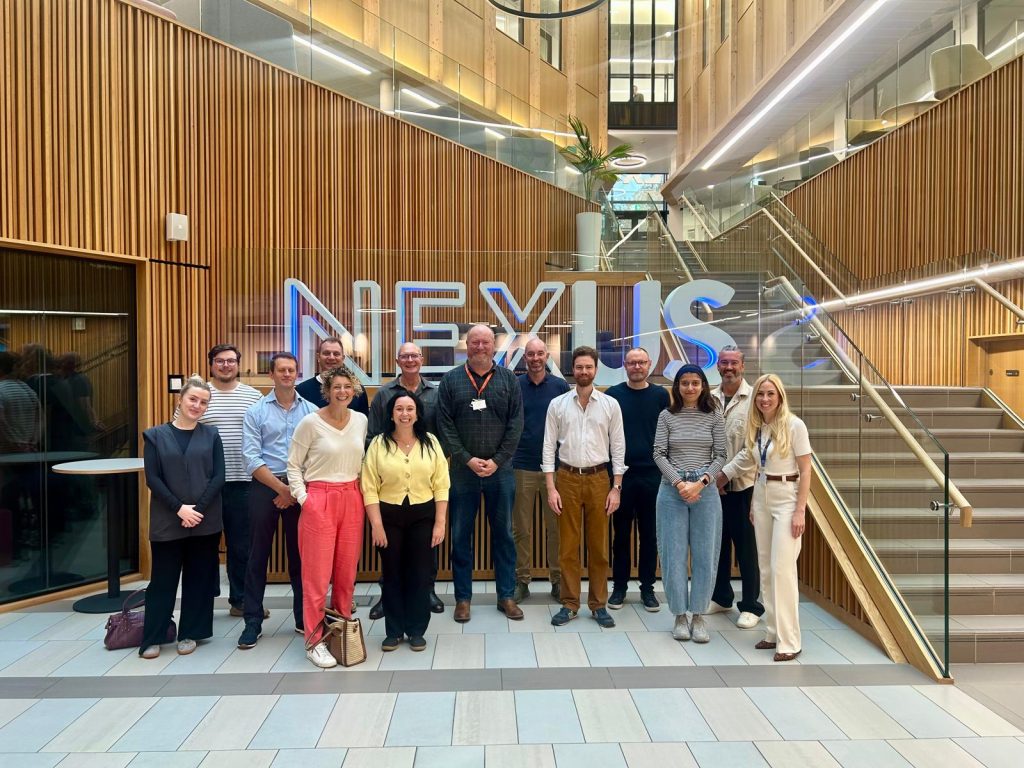
Day two focused on the University of Leeds’ Nexus innovation hub, led by Engagement Manager, Barry Singleton. Delegates explored Spark, the university’s progressive startup and entrepreneurship support service for students, and met business founders transitioning academic research into scaling commercial enterprises.
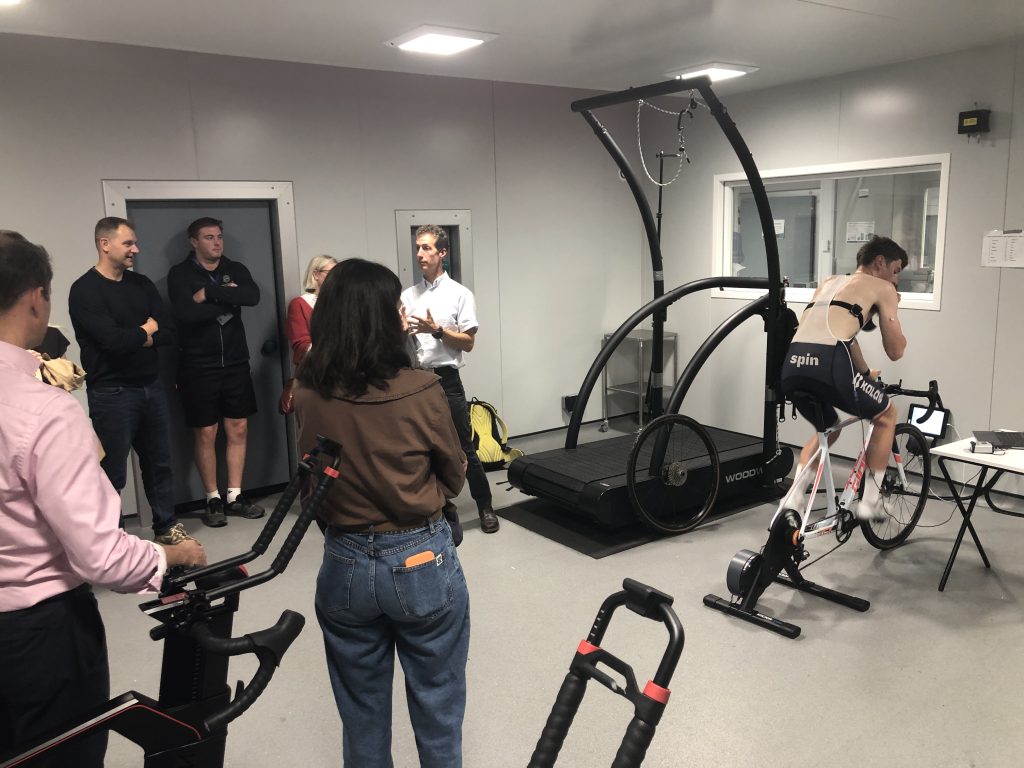
A major highlight of the day was a tour of Virtuocity at the University of Leeds, guided by Programme Manager Peter Woodthorpe. Virtuocity’s immersive pedestrian, vehicle, and transport simulators provide a testbed for safer, smarter urban mobility solutions with a clear focus on behaviour change linked to the cutting edge technologies. The facility gave UK IDG Members hands-on experience of how Leeds are pioneering projects built on the principles of academic, industry and community co-design.
The study visit concluded at Nexus with the UK IDG Members Meeting, where attendees convened to address national policy, research initiatives, the launch of a new Innovation Ecosystem Accelerator and other strategic network priorities.
Emma Frost, Chair of UK IDG, said, “The progress in Leeds is fantastic to see. Nexus is a good seven years on from when we first visited it and the model has proved a huge success. This serves as a strong example of how clear vision and cross-sector collaboration builds resilient, inclusive innovation economies that return real value to the places they belong; something that we at UK IDG are all about enabling.”




Learning Points
- Sustainable financing and business models: As UK IDG prepares its 2027 Action Research Project on sustainable funding structures, the Leeds study visit offered a valuable reference point. By combining public-private partnerships, investment zone funding, and institutional support from the Local Authority and West Yorkshire Combined Authority, universities and health trusts, Leeds illustrates how districts can achieve long-term operational sustainability.
- Crowding in investment: Aligning with UK IDG’s recent workshops and upcoming briefing paper on Crowding in Investment to Innovation Hubs and Districts, Leeds shows how clear spatial frameworks like the Innovation Arc create confidence for private and institutional capital.
- Ecosystem acceleration and talent pathways: Leeds demonstrated how it is integrating university IP adoption, focused business support through programmes like Spark within a research setting, local skills development, and community outcomes. This approach can be used as a blueprint for regional innovation hubs nationwide.
UK place leaders meet together for UK IDG Study Visits twice yearly and the spring 2027 location will be announced soon. If you’re someone that works in place-based innovation and would like to learn more about the UK IDG programme of events, research, and knowledge-share, please email hello@ukinnovationdistricts.co.uk.
UK Innovation Districts Group (UK IDG) has launched the Innovation Ecosystem Accelerator Programme to empower place leaders nationwide.
Registration is open now for Cohort One, taking place from February to August 2027. Learn more and Register here.
This pioneering Accelerator is designed to help local authorities, university leaders, regional development agencies, and innovation district teams unlock the full economic potential of their local innovation ecosystems.
The seven-month programme addresses a critical gap in regional economic development: turning isolated assets, research institutions, and innovation hubs into cohesive, high-performing ecosystems. Ecosystems that attract investment, foster entrepreneurship, and drive inclusive growth.
Despite significant capital investments across UK towns and cities and a growing evidence base demonstrating economic and community impact, many regions are still struggling to achieve long-term momentum from their innovation ecosystems, often due to fragmented governance, mismatched stakeholder priorities, and lack of operational capacity.
The Innovation Ecosystem Accelerator offers a structured programme of activity, a peer group and a pathway, designed by experienced practitioners, and tailored to the specific circumstances of a place, its people and operational systems.
Over seven months, participants will work through practical modules covering governance alignment, ecosystem capital strategies, anchor-institution activation, and sustainable value creation. Lifting concepts from regional collaboration agreements into impactful delivery, the accelerator ensures participating leadership teams emerge with a stress-tested, actionable place-based plan for their innovation ecosystem.
The Accelerator is a UK Innovation Districts Group programme, delivered by Recurve and Fern Consulting.
Emma Frost, Chair, UK Innovation Districts Group and Director, Fern Consulting Ltd, said: “Building a thriving innovation ecosystem isn’t about having more buildings, strategies or sector labels – it’s about turning local assets, relationships and leadership into a system that creates real opportunity.
“The Accelerator gives place leaders practical tools, independent challenge and peer support to test what’s possible. It helps align partners behind a shared ambition, and move from good intentions to an investable, inclusive plan for their place.”
Sam Markey, Founder and Managing Director, Recurve.“Place-based leaders face an unprecedented challenge, balancing local socio-economic priorities with global competitiveness.”
“Through the accelerator, and our free interactive diagnostic tool, we are helping leadership teams identify their precise ecosystem gaps and turn strategic intent into tangible, fundable application.”
For those in exploration mode, there is a free online Ecosystem Diagnostic Tool to support regional teams to evaluate their strengths across key dimensions, including governance, capital flow, and ecosystem narrative. The tool provides instant benchmark insights and can be used to support accelerator applications.
Applications for Cohort One are now officially open. Place-based leaders, economic development officers, and regional partners can register their interest here: https://www.ukinnovationdistricts.co.uk/innovation-ecosystem-accelerator/
UK Innovation Districts Group’s (UK IDG) latest landmark report demonstrates the significant economic and social impact of UK innovation districts.
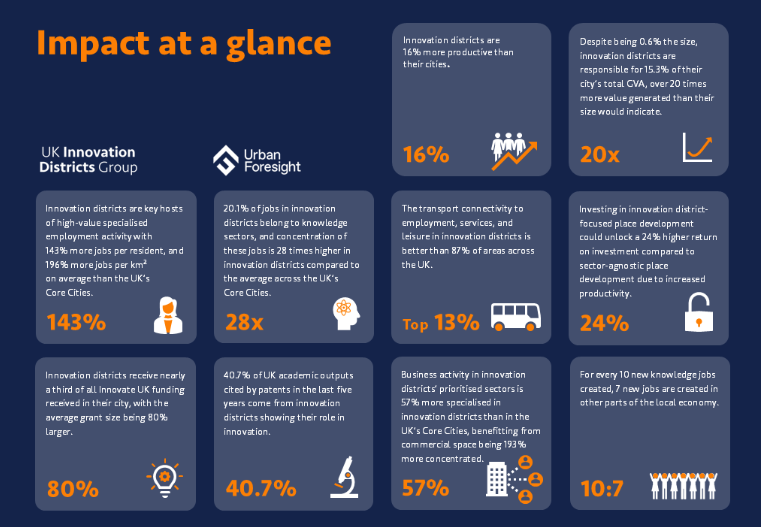
- Innovation districts are 16% more productive than their city average.
- Innovation districts deliver 24% higher return on investment than sector agnostic place development sites.
- Innovation districts generate 15.3% of their city’s total GVA despite being just 0.6% of their city’s size (more than twenty-times the return relative to their size).
- Innovation districts host 143% more jobs per resident and 196% more jobs per km² than the UK’s Core Cities average.
- 20.1% of jobs in innovation districts belong to knowledge sectors, and concentration of these jobs is 28 times higher in innovation districts compared to the average across the UK’s Core Cities.
- For every 10 new knowledge jobs created, a further 7 jobs are created elsewhere in the local economy.
- Innovation districts secure nearly a third of all Innovate UK funding received in their city, with the average grant size being 80% larger than grants issued outside the innovation district.
- 40.7% of UK academic outputs cited by patents in the last five years come from innovation districts showing their role in innovation.
- Innovation districts are 8% less deprived than the average across the UK’s Core Cities.
Commissioned by UK IDG and prepared by Urban Foresight, the report, “The power of data for Innovation Districts“, introduces a new data-dashboard combining 92 indicators to analyse performance across the three stages of the innovation cycle: design, delivery, and diffusion. The data tracks how innovation districts turn investment into impact. The full report examines the availability of localised publicly accessible data, the challenges of data collection and interpretation to measure ‘impact’, and makes recommendations on how innovation districts can collect and use data moving forward to clearly demonstrate the ‘value’ of innovation districts as vehicles for inclusive economic growth.
Developed to help overcome persistent barriers in localised public data accessibility, the dashboard provides a roadmap for evidence-based place-making.
The findings reveal that innovation districts are highly productive powerhouses that have a central role to play in delivering the UK Industrial Strategy. Despite occupying just 0.6% of their cities’ physical size, they generate 15.3% of total GVA – an economic return more than twenty times their footprint. Furthermore, UK innovation districts are 16% more productive than their surrounding cities, translating into a 24% higher return on investment compared to other sector-agnostic developments. They also act as critical R&D magnets, hosting 143% more jobs per resident and securing nearly a third of all municipal Innovate UK funding, with an average grant size 80% larger than elsewhere in their cities.
The power of data for Innovation Districts
Emma Frost, Chair of the UK Innovation Districts Group, said: “This data shows that innovation districts are powerful catalyst sites, helping to transform the fortunes of UK urban economies. By capturing these insights, and developing a roadmap for data collection and data exploration, we are supporting place-based leaders across the UK to build their business case, design their places, and attract investment for maximum return.
“With a 24% higher return on investment and a demonstrable 16% uplift in productivity, investing in targeted innovation districts is a proven path to regional growth. Moving forward, establishing shared local data standards will be vital to unlock their full potential and shape long-term UK economic policy.”
Eamon Banerjee, Consultant for Urban Foresight, said: “Innovation districts are increasingly recognised as catalysts for economic growth, but understanding their true impact requires looking beyond headline economic indicators.
“Through this analysis, we found that the most meaningful impacts of innovation districts are often not captured by conventional measures alone. This new framework provides a more complete picture of how investment is translated into innovation, business activity and wider place-based outcomes. The framework is designed to help places access funding support, understand what makes their places work, and make more informed strategic decisions.”
The report delivers benchmark data to all UK IDG Members and makes recommendations for UK innovation districts and knowledge quarters to build robust local data partnerships and internal analytical capacity. This will enable onward measurement of broader socio-economic outcomes and support place leaders to collaborate on highly productive, inclusive urban renewal.
At last week’s UK Innovation Districts Summit 2026 in Liverpool, a vital conversation took centre stage: ‘Public opinion on R&D and innovation: why it matters and what next.’ We sat down with David Marlow (Chief Executive, Third Life Economics) and Jane Robinson (Pro Vice-Chancellor, Business, Partnerships and Place, Newcastle University) to unpack a reality that every innovation district leader in the UK must now confront.
While our districts are engines of economic growth and scientific breakthroughs, a widening disconnect is forming right on our doorsteps. If we want our ecosystems to be sustainable, we have to change how we engage with, and deliver value to, our local communities.
Here are the key takeaways from the discussion and what they might mean for your leadership strategy.
1. Public Perception of ‘value’
The majority of people support the need for R&D funding. In particular, they support university medical research and understand its potential to save lives and improve health outcomes. The Campaign for Science and Engineering (CaSE) Public Attitudes Study found that 88% of people support the need for Government funding into R&D activity but actually only 18% of people state that they feel any benefits of this in their immediate area or for their family.
The takeaway for leaders: For too long, the “value” of an anchor institution has been abstract or inward-facing. If local people feel that the knowledge generated in our districts is detached from their daily lives or that the career pathways we create are out of reach, we risk losing our social license to operate. We must bridge this gap by really strengthening university-community links.
2. Putting “Place” and “People” First
How do we fix this? The duo discussed a strategic framework for innovation districts that shifts our focus from purely property-led development to human-centered placemaking, and referenced a recent report: Driving Inclusive Innovation.
True inclusive innovation isn’t a byproduct of growth; it must be intentionally designed. As leaders, our role is to connect the research strengths of our universities directly with the immediate opportunities and challenges within our local communities. There is also a direct call to focus on human-centered design in the development of districts both in physical estate and facilities access terms but also in the services and programmes that we run.
3. Measuring What Matters: Frameworks for Inclusive Metrics
You can’t manage what you don’t measure. The summit highlighted the urgent need to rethink the metrics we use to measure success for innovation districts and ensure they focus on outcomes and inclusive growth just as much as jobs and GVA. UK IDG has been working on this to co-design a Framework for Innovation District Metrics.
Stakeholders across districts need a standardised vocabulary and dataset to articulate their inclusive innovation ambitions. We need to move beyond traditional metrics like “square footage developed” or “venture capital raised” and start tracking indicators that prove local wealth building, community health improvements, and economic resilience at neighbourhood-level.
4. Creating Real Pathways: The “Building Blocks” Model
Inclusive innovation requires tangible programmes, not just policy papers. A standout example discussed was BUILDING BLOCKS. Newcastle Helix’s BUILDING BLOCKS work experience model is based around a ‘work placement safari’, where rather than relying on a one-week placement with a single employer students are exposed to a range of experiences involving real workplaces, real people and real skills.
This initiative is actively breaking down barriers, directly connecting young people with global industry partners and government stakeholders. By scaling projects like this, innovation districts can provide life-changing, practical exposure to young people who might otherwise feel completely alienated from the innovation economy – as this recent film about the Future of Work Experience explains.
5. Co-Design: Engaging Communities Early
Jane Robinson shared critical insights from Newcastle, emphasizing that community engagement cannot be an afterthought or a “tick-box” exercise at the end of a project.
Newcastle University’s approach relies heavily on involving local communities early in the design phase of innovation projects. When residents are treated as co-designers of the district’s priorities, the resulting innovations are more relevant, more trusted, and far more likely to deliver genuine local impact.
6. Navigating the Complexity of Diverse Regions
Finally, the panel tackled a systemic hurdle: the sheer difficulty of scaling university-driven innovations across vastly different political and regional landscapes in the UK. What works in a highly devolved combined authority might stall in a different regional context. Just as what works in an inner city district might be different from a semi-rural town.
To succeed, innovation district leaders must advocate for regional certainty and tailor their value proposition to the specific political and economic realities of their geography. Innovation must be made highly relevant to local political leaders and public priorities to secure long-term backing.
What Next for District Leaders?
As leaders, we must use our convening power to co-design our districts with the people who live, work and study in them. By adopting inclusive metrics, investing in early community engagement, and building concrete pathways for people to get real value from a district (like Building Blocks in Newcastle), we can shift the dial on public opinion.
What steps is your district taking to co-design with your local community? Let us know by joining the conversation on LinkedIn.